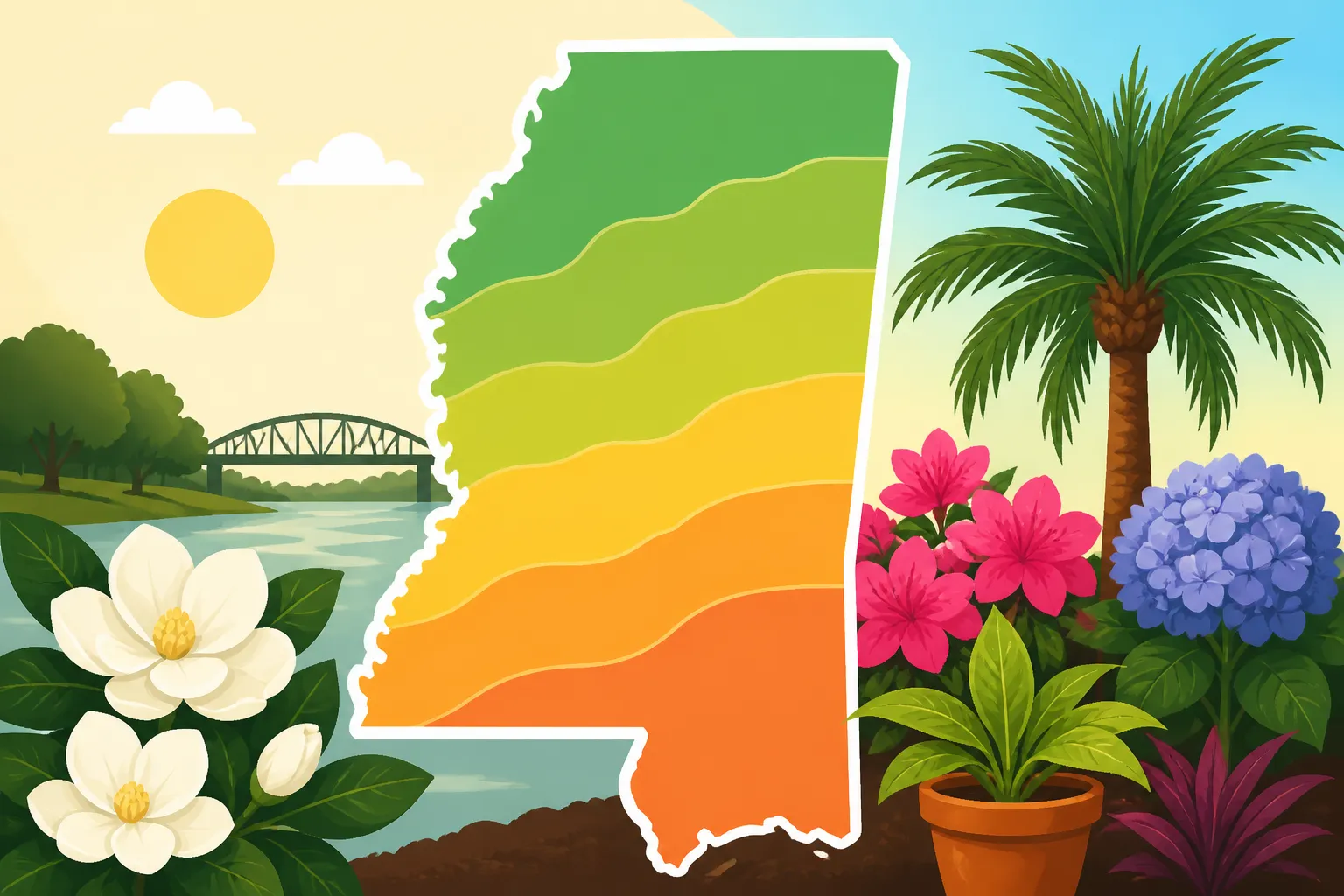
Mississippi Hardiness Zones: Understanding the 7b to 9a Range
Mississippi gardeners often see hardiness zones used to describe which plants can survive winter, then find that the zone alone does not tell them when to sow or transplant. Understanding what the map measures, how yard conditions affect it, and where it fits into a planting plan makes it easier to choose plants without treating a zone label as a calendar.
What Mississippi hardiness zones measure
The USDA Plant Hardiness Zone Map is a tool for estimating how well perennial plants may tolerate the coldest winter conditions in a location. Its zones are based on average annual extreme minimum winter temperatures. In practical terms, the map offers a broad clue about winter cold—not a forecast for a particular season or a promise that a plant will thrive.
According to Mississippi State University Extension Service, much of Mississippi is in USDA 2023 plant hardiness zone 8b.
That statewide description is useful, but it does not mean every yard has identical growing conditions. A map divides a varied landscape into broad areas. Even within one general zone, elevation, exposure, drainage, nearby structures, and other local conditions can create warmer or colder spots.
Hardiness zones are most helpful when you are choosing plants that need to survive outdoors year after year. A perennial, shrub, or tree that cannot tolerate the winter cold typical of its location may be damaged or killed, even if it grows well during the rest of the year. A plant’s listed hardiness range can help narrow the options, but it is only one part of the decision.
The map is less useful for answering questions such as when to plant tomatoes, when to sow lettuce, or whether seedlings can go outside this week. Those decisions depend on seasonal temperatures, frost risk, soil warmth, crop maturity, and local weather. A hardiness zone does not tell you when the last spring frost will occur, how long a heat spell will last, or whether a sudden cold snap is on its way.
It also does not describe every aspect of a plant’s needs. A plant may be able to survive winter in a location but still struggle there because it receives too little sun, sits in wet soil, or cannot tolerate summer heat and humidity. Conversely, a plant that is not a perfect match for the broad map label may do well in a sheltered spot with suitable soil and care.
Use the zone as a screening tool. It can help you decide whether a plant is a reasonable candidate for outdoor survival, but it cannot replace checking the plant’s other requirements or observing your own yard. For a broader seasonal overview, see Mississippi Planting Guide: What to Grow by Season and Zone.
How to read a zone map without overreading it
A hardiness map should be treated as a regional guide, not as a precise description of the conditions at your back door. Its colored areas show broad patterns. The boundaries are useful for organizing information, but nature does not follow a sharp line across a property or neighborhood.
When you look up a location, begin with the general area shown on the map. Then consider whether your specific yard differs from the surrounding landscape. A location near a building, paved surface, slope, or exposed open area may experience different conditions from a nearby garden. Those differences matter particularly for plants near the edge of their winter tolerance.
A ZIP-code lookup can be a convenient starting point, but it cannot account for every yard-level detail. The result should not be treated as a guarantee for an individual address. If you are choosing a long-lived tree or shrub, compare the map result with the plant’s stated requirements and consider the conditions where it will actually grow.
Look beyond the color on the screen
Map colors can make a zone boundary look more exact than it is. Zooming in does not necessarily make the underlying information precise enough to describe a single planting bed. Instead of making a decision based only on a boundary, use the map to understand the broader regional pattern, then consider the site.
Ask practical questions about your yard:
- Is the planting spot exposed to open wind or protected by nearby structures?
- Does cold air seem to collect there, or does the area warm quickly?
- Is the soil likely to drain freely, or does water remain after rain?
- Does a wall or paved surface make the spot warmer than nearby ground?
- Is the location consistently sunny, shaded, or somewhere between?
These observations do not change the official map label. They help you decide whether a particular place in the yard is more exposed, more sheltered, wetter, or warmer than the broader area around it.
Treat plant labels as a starting point
Plant tags and catalogs may list a hardiness range, but the label rarely answers every question that matters in Mississippi. Check whether the plant also needs a certain amount of sunlight, a particular soil condition, or protection from persistent wetness. Consider summer stress as well as winter survival.
For example, a plant may tolerate winter cold but perform poorly in a hot, exposed bed. Another may grow well through warm weather but be vulnerable to a cold snap. A successful choice must suit the whole site and the conditions across the growing year, not only the coldest part of winter.
When comparing options, look for plants described as suitable for your general region and match those claims against the conditions in your garden. If a plant is near the limit of its stated tolerance, consider whether you can provide a suitable site and whether you are comfortable with the possibility of winter injury.
For help relating map labels to garden choices, Matching Landscape Plants to Mississippi Hardiness Zones can be paired with a close look at sunlight and drainage. Those site conditions often determine whether a plant that appears suitable on paper will actually settle in well.
Why a hardiness zone is not a planting calendar
A zone describes winter cold patterns; it does not tell you when to plant annual vegetables or flowers. Those crops are usually managed around changing seasonal conditions rather than long-term winter survival. The right time to sow or transplant depends on what the crop can tolerate at that stage of growth and what the weather and soil are doing.
A spring planting date, for instance, may depend on the risk of frost and whether the soil has warmed enough for the crop. A fall planting date may depend on how much time remains for a plant to mature before cold weather arrives. Neither question can be answered from the zone label alone.
This distinction is important because a garden can experience conditions that do not match the average implied by a map. A winter cold snap can damage tender plants, even in a generally mild area. A warm spell can also arrive before the risk of frost has passed. Seasonal weather varies, so a zone cannot promise that a particular week will be safe.
Use the right timing tool for the decision
For trees and perennial plants, start with winter hardiness, then check sunlight, drainage, soil, and the plant’s tolerance for summer conditions. For vegetable planting, use crop-specific timing information and local frost guidance. For moving seedlings outdoors, consider their readiness as well as current weather.
A useful planning sequence is:
- Decide what you want to grow and whether it is an annual or a plant expected to survive outdoors for multiple years.
- For long-lived plants, check winter tolerance and match it to the broad conditions in your area.
- For seasonal crops, consult planting windows that account for frost, heat, soil warmth, and crop maturity.
- Assess the exact planting site for sunlight, drainage, exposure, and nearby hard surfaces.
- Recheck the forecast and current conditions before taking a step that could expose tender plants to cold.
This approach keeps the map in its proper role. It helps filter choices, while crop calendars and current conditions help determine timing.
For vegetables, compare a broad calendar with crop-specific information rather than assuming that one general planting date works across the state. Mississippi Year-Round Vegetable Gardening Calendar by Month can help organize seasonal plans, while Mississippi Frost-Date Gardening: Timing Cool vs. Warm Crops explains why frost risk matters for different crops.
Use frost information carefully
Frost dates describe probabilities, not fixed appointments. Even a date that is useful for planning does not guarantee that frost will or will not occur on a particular night. The likelihood of frost changes from year to year, and local conditions can differ from the conditions represented by a broader estimate.
A hardiness zone and a frost date answer different questions. The zone helps estimate whether a perennial may survive typical winter cold over time. Frost information helps you plan around the possibility of cold during a particular part of the growing season. Neither tool replaces checking the forecast when a cold night is approaching.
When planting vegetables, decide whether a crop is sensitive to frost, whether it can be protected, and whether the expected growing window suits its needs. For a more detailed explanation of local timing, see How to Gauge Spring Freeze Risk When Planting Mississippi Seedlings and How to Pick Sowing Dates Using Mississippi’s Regional Zones.
How local conditions can change plant performance
The map’s broad regional picture is only one part of the growing environment. Conditions can vary across a single yard, and those differences may affect both winter survival and performance through the growing season.
Microclimates around the home
A microclimate is a small area whose conditions differ from those nearby. A sheltered bed beside a building may not experience the same exposure as an open garden. A paved area can affect nearby conditions, while a low spot may hold cold air or moisture differently from a higher, more open area. Trees and fences can also change shade, airflow, or exposure.
These differences are not a reason to ignore the map. They are a reason to use it as a starting point and then observe the planting site. If a plant struggles in one location, its failure may point to a site problem rather than a mismatch with the broad zone.
Pay attention to repeated patterns. Notice where frost lingers, where soil remains wet, where afternoon sun is strongest, and where wind is most noticeable. Your observations can help you place sensitive plants in more suitable locations and avoid repeating a poor placement.
For a deeper look at how these small-scale differences affect planting plans, see How Local Microclimates Alter Mississippi Planting Zone Dates.
Soil and drainage matter alongside winter cold
A plant’s ability to survive cold does not guarantee that it will tolerate the soil in a particular bed. Soil that drains poorly can keep roots wet for too long. A dry, exposed spot may place different stress on a plant than a bed with more moisture and shelter. The same plant can perform differently in two areas of the same yard because the growing conditions differ.
Before planting, inspect how the site behaves after rain and during dry weather. Look for standing water, compacted ground, or places that dry out quickly. Consider whether the planting area gets the light the plant needs. These basic checks can prevent a common mistake: choosing a plant based on hardiness alone and overlooking the conditions that will affect it every day.
Site assessment is especially valuable for trees and shrubs. They remain in place for a long time, so a poor match between plant and site can be difficult to correct later. Assessing Sunlight and Drainage Before Choosing Yard Plants offers a useful companion approach for evaluating a planting location before committing to a plant.
Summer conditions are part of the decision
Hardiness zones focus on winter cold, but Mississippi gardeners also need to consider hot weather, humidity, and periods of dry soil. A plant that can survive winter may still be poorly suited to a sunny, exposed location or a humid site where its foliage stays wet. A plant’s winter rating does not measure its ability to thrive through summer.
When selecting plants, look for descriptions that address more than winter tolerance. Check whether the plant prefers full sun or shade, whether it needs well-drained soil, and whether it is described as suitable for the conditions you can provide. In a challenging spot, prioritize plants suited to that specific exposure and soil rather than trying to force a less suitable choice.
This broader view also helps explain why a garden can succeed in one season and struggle in another. Winter survival, spring growth, summer performance, and fall recovery are related but not identical challenges. A zone label contributes one piece of the decision, not a complete forecast of how a plant will behave.
A practical way to use zones in a Mississippi garden
Hardiness zones are most useful when they are part of a simple decision process. Start with what you want to grow, identify what conditions it needs, and compare those needs with both the regional map and the planting site.
For trees, shrubs, and perennials
Begin by checking whether the plant is expected to survive winter in your general area. Then evaluate the planting spot. Consider winter exposure, summer sun, drainage, available space, and whether the plant needs shelter or consistent moisture. A suitable map label cannot make an unsuitable location work.
For a plant near the edge of its stated tolerance, be deliberate. Choose a protected location if the plant’s needs and the yard allow it. Think about whether the plant is worth the risk if a colder-than-usual winter causes damage. If replacing a plant would be difficult or costly, a better-matched option may be the more practical choice.
Avoid treating a hardiness range as a guarantee. Plant labels summarize general survival expectations; actual results can vary with weather, the age and health of the plant, the planting site, and care. A plant that survives a winter may still suffer damage, while a suitable microclimate may improve its chances.
For vegetables and annual flowers
For seasonal crops, use a planting calendar that accounts for crop needs and local conditions rather than choosing dates from the hardiness map. Decide whether you are sowing seed directly or setting out transplants, since those methods can have different timing considerations. Check soil conditions and weather before planting, and be ready to adjust when conditions change.
Keep records of what you planted and how it performed. Note whether a crop was exposed to frost, struggled in heat, or grew well in a particular bed. These observations can help you refine future plans without confusing a single season’s weather with the long-term pattern represented by the map.
For crops that have both spring and fall planting windows, plan each season separately. A successful spring schedule does not automatically work for fall, because the direction of temperature change and the available growing period are different. When to Plant Cool-Season Vegetables in Mississippi: Spring & Fall can help you think through that seasonal distinction.
For a new garden or an unfamiliar yard
If you have recently moved or are starting a garden from scratch, avoid making a large purchase based only on a zone lookup. Begin with a few plants suited to the intended site, observe how the yard behaves, and expand as you learn. Different beds may have different sun, drainage, and exposure, so a single zone result cannot describe every planting area.
A new gardener may find it helpful to separate decisions into two categories:
| Gardening decision | Best starting point | What the zone can contribute |
|---|---|---|
| Choosing a tree or shrub | Plant requirements and the planting site | A broad check on winter survival |
| Selecting a perennial | Hardiness information, sunlight, and drainage | A regional screening tool |
| Planning vegetable sowing | Crop-specific planting windows and weather | Very little help with exact dates |
| Moving seedlings outdoors | Seedling readiness, frost risk, and conditions | Not a substitute for local timing |
| Diagnosing poor growth | Soil, water, light, pests, and disease | May help rule out winter survival as the only issue |
This comparison is a reminder to match the tool to the question. A map can narrow a list of plants, but it cannot supply a full planting schedule or diagnose a garden problem.
Common mistakes when interpreting Mississippi zones
Assuming a zone boundary is a property boundary
A map boundary is not a wall that separates one kind of garden from another. Nearby areas can share similar growing conditions even when the displayed line falls between them. A location near a boundary should be treated with care, but the line alone does not determine what will grow in a particular bed.
Treating winter survival as year-round suitability
A plant may be hardy enough for winter yet poorly matched to summer heat, moisture, soil, or sunlight. Consider all the conditions that shape growth, not only cold tolerance. This is especially important for plants expected to remain in the landscape for years.
Using the zone to choose sowing dates
A hardiness zone does not tell you whether garden soil is warm enough for a seed or whether a transplant is ready to go outside. Use crop-specific timing and current conditions for those decisions. When frost is a concern, use frost guidance and monitor the forecast instead of relying on the zone label.
Treating a lookup as a guarantee
A map or ZIP-code result is a regional estimate. It cannot account for every change in elevation, wind exposure, drainage, shade, or shelter in an individual yard. Use the result as one clue, then check the plant’s requirements and the site.
Ignoring the plant’s own needs
A plant’s hardiness information does not replace its care requirements. Confirm its preferences for light, soil, moisture, and spacing. If a plant repeatedly struggles despite being described as hardy for the region, investigate those conditions before concluding that the zone information is wrong.
Frequently Asked Questions
Does a hardiness zone tell me what vegetables to plant?
Not by itself. It can offer broad context about winter cold, but vegetable choices and planting dates depend on crop-specific needs, seasonal weather, frost risk, and the garden site.
Can two gardens in the same area have different results?
Yes. Sunlight, drainage, exposure, shelter, and other site conditions can differ from yard to yard. The same plant may perform differently in two nearby locations.
Should I use a zone lookup or a planting calendar?
Use each for the question it answers. A zone lookup can help screen long-lived plants for winter survival, while a planting calendar and local weather information are more useful for scheduling seasonal crops.
Does a suitable zone guarantee that a plant will thrive?
No. It suggests that winter cold may be within the plant’s tolerance, but it does not account for every cause of poor growth. Check the plant’s full requirements and the conditions at the planting site.
Disclaimer
This article is for general informational purposes only and does not constitute professional advice. Laws, prices and regulations vary by location and change over time. Consult a qualified professional for guidance on your specific situation. Mississippi Gardening Guide is not a government agency and is not affiliated with any university extension, state department of agriculture or other government agency.